Showing posts with label menswear. Show all posts

Friday, 27 June 2014

The 85+ Ways to Tie a Tie, now in Technicolor! (Knots 1 to 3)

In 1999, researchers Thomas Fink and Yong Mao at Cambridge University published a book entitled The 85 Ways to Tie a Tie. They came up with a number of criteria to limit their list of possible knots and actually published a pair of research papers on the subject in Nature and Physica A.

Not to be outdone, and disappointed that Fink and Mao ignored some pretty cool looking knots, a group of mathematicians eliminated most of the restrictions Fink and Mao had used and in 2014 published a paper proving that there were actually 177,147 ways to tie a necktie. However, even the authors had to admit that many of their knots were not very aesthetic, so it seems the criteria of Fink and Mao were not unreasonable, even if they did exclude a few good knots.

I've got a decent collection of ties and like to experiment with knots, so I've decided to work my way through all the Fink-Mao knots (plus many of the excluded knots) in this series of posts on tie knots. Click here to see a list of all the knots I've documented.

In this post I bring you knots 1 through 3, plus several variations. Almost all knots can be tied to look like the Onassis knot by either dropping the "T" from the end of the sequence of moves, or (more securely) by adding either "Li Co" or "Ri Co" to the end of the sequence. Knots can also be tied to show off what the back of the knot looks like by mirroring all the moves. Some knots look interesting in reverse and I will occasionally wear a reversed knot just to be different. I will be using the Fink-Mao notation to describe how the knots are tied. If you are unfamiliar with the notation, click on the link provided to get caught up.

Knot 1

Better known as:  Small knot, Oriental knot, Kent knot

How it's tied:  Lo Ri Co T

Additional notes: 
  • Smallest of all the tie knots. 
  • Narrow end usually extends past the wide end and will have to be hidden in some way. I usually tuck the narrow end into my shirt. 
  • Looks bad when paired with a spread collar because the collar space is way too big.
  • I find that it tends to loosen easily due to having so few moves holding it together.

What it looks like:

Kent knot (Lo Ri Co T)


Variations:
  • Onassis ending, loose (Lo Ri Co)
  • Onassis ending, secure (Lo Ri Co T Li Co)
  • Reversed knot (Ri Lo Ci T)

Kent knot, Onassis variant (Lo Ri Co)

Kent knot, Onassis variant (Lo Ri Co T Li Co)

Reverse Kent knot (Ri Lo Ci T)


Knot 2

Better known as:  Four-in-hand knot, Simple knot, Schoolboy knot

How it's tied:  Li Ro Li Co T

Additional notes: 
  • Difficult to make it look symmetrical. If you like symmetry you should probably stick to other knots.
  • A popular knot to wear loose with the collar button open.
What it looks like:

Four-in-hand knot (Li Ro Li Co T)

Variations:
  • Onassis ending, loose (Li Ro Li Co)
  • Onassis ending, secure (Li Ro Li Co T Ri Co). Most references to "Onassis knot" are referring to this particular knot.
  • Reversed knot (1/2 twist Ro Li Ro Ci T). A half twist is required before the first move in order to hide the tie's seam.

Onassis knot (Li Ro Li Co T Ri Co)

Four-in-hand knot, Onassis variant (Li Ro Li Co)


Reversed four-in-hand knot (1/2 twist Ro Li Ro Ci T)

Reversed four-in-hand knot (1/2 twist Ro Li Ro Ci T)

Knot 3

Better known as:  Kelvin knot

How it's tied:  Lo Ri Lo Ri Co T

Additional notes:  
  • Can be difficult to tie a knot that looks symmetrical
  • Has aesthetically pleasing variants known as the Cross Kelvin knot and the Diagonal knot.

What it looks like:

Kelvin knot (Lo Ri Lo Ri Co T)

Kelvin knot (Lo Ri Lo Ri Co T)


Variations:
  • Onassis ending, loose (Lo Ri Lo Ri Co)
  • Onassis ending, secure (Lo Ri Lo Ri Co T Li Co)
  • Cross Kelvin knot (Lo Ri Lo Ri Co TT)
  • Reverse Kelvin knot (Ri Lo Ri Lo Ci T)
  • Diagonal knot (reverse cross Kelvin knot) (Ri Lo Ri Lo Ci TT)

Kelvin knot with Onassis ending (Lo Ri Lo Ri Co T Li Co)
Kelvin knot with Onassis ending (Lo Ri Lo Ri Co)


Cross Kelvin knot (Lo Ri Lo Ri Co TT)


Reverse Kelvin knot (Ri Lo Ri Lo Ci T)

Reverse Kelvin knot (Ri Lo Ri Lo Ci T)


Diagonal knot (Ri Lo Ri Lo Ci TT)

Diagonal knot (Ri Lo Ri Lo Ci TT)


Saturday, 26 April 2014

Anson Belt & Buckle Review: Part 2

It's been a long time, but I'm finally following up on my initial review of my Anson Belt & Buckle purchase. For the benefit of those too lazy to read all the details, here's the important information:
  • These belts have stood up to my abuse and exceeded my expectations.
  • My opinion of them is very positive. I would recommend Anson Belt & Buckle to anyone and I would consider buying from them again if I need a belt in the future for myself or for a gift to somebody else.
  • Anson Belt & Buckle reports that they've changed suppliers and improved their straps since the time these belts were purchased, meaning the products they currently sell aren't quite the same as what I've reviewed. 

And now for the full analysis. First, I'll mention that the co-founder, David Ferree, commented on my first post. Evidently my review gets enough traffic to warrant attention from the company. David expressed concern that my previous review contains negative elements that might discourage potential customers and he points out some relevant errors and omissions I made. He also offered a full refund if I was dissatisfied and returned the belts, so good on them for making customer satisfaction a high priority. That said, I will not delete or substantially revise my original post (though I have added a brief note at the beginning of it). At the time that I wrote the first part of the review it was accurate to the best of my knowledge and an honest account of my opinions and experiences. Nevertheless, I think David's comments and concerns (I've quoted him verbatim in italics) are valid, so I'll address them here:
  1. Our individual straps and buckles actually sell for $24.95 and and [sic] a complete belt for $49.90.
    I checked the website recently (which has been redesigned since my previous visit) and confirmed that individual buckles and straps are currently priced at $24.95 USD, so a complete belt is just under $50 before taxes, shipping, and any other applicable fees. They've also added several more straps and buckles to choose from, so there's a lot more selection available than when I bought my belts.
  2. We also have a Lifetime Guarantee which I don't think you mentioned.
    I didn't mention the guarantee in the first post because I was unaware of any guarantee. But in my recent visit I found that it is plainly visible on the splash page that Anson Belt & Buckle offers some kind of lifetime guarantee. That definitely offers some reassurance to potential new customers. However, I can't find any further information regarding the guarantee. There is usually some information on these things written in 'legalese' to mitigate against frivolous claims or people generally abusing the policy.
  3. I think that overall your feeling and perception of our product was a positive one...Indeed, my opinion of the product was generally positive. I had some reservations about the quality and durability and described them honestly. 
In a separate email to me, David stated that they've changed suppliers since I made my order and that their straps have been improved upon. I can't verify that statement without buying and testing another belt, but based on all the changes I saw on the website, I'm not surprised that the supplier has changed too. It also means that the belts I have are at least slightly different from the products Anson Belt & Buckle is currently selling.

On to the actual belts. I have been wearing the dark brown belt about 3 to 4 times a week for the past year. Here are a few recent photos of it to show you what it looks like today:

Brown leather belt looks warped after wearing it for a year.
The kink formed where the belt's pinched by my belt loop when I sit.

Close-up of the outer side of the belt at the kink.

Close-up of the top finished edge of the belt at the kink.
The edge finishing has started to separate from the strap.

Close-up of the top finished edge of the belt at the tongue.

The belt buckle I wear most often. A little scratched but nothing obvious from afar.

I think the kink in the belt is normal if you sit a lot, so in and of itself the kink didn't concern me. The edge finishing has taken some damage, but the damage hasn't propagated. It looks like the strap's edge finishing is mediocre while the rest of the belt of good quality. I may be critical, but I'm not unreasonable; the flaws I've highlighted are practically invisible and I'm generally quite pleased with the belt.

In addition to wearing a belt for a year, I also subjected the cut end (the one I didn't dissect) to a harsh test of my own design to simulate long-term use and severe abuse. I tested the durability of the buckle's lever, buckle's surface finish, and the leather strap, spread out over a year so that I wouldn't lose my mind doing the experiment. I've reported my findings below:

Buckle Lever Durability
Test description: I opened and closed the lever a total of 3000 times to simulate taking off or adjusting the belt. I was a little rough too, pressing the latch to its limit in both directions using firm pressure with my thumb. This was to make sure it could handle repeated forces beyond what you need to just make it work.

Result: The buckle still works like it was new.

Buckle Finish Durability
Test description: I scratched the buckle (in an inconspicuous area so I could still use it afterward) a total of 100 times to simulate accidental abrasion from carrying awkward large objects or brushing up against a wall. I alternated between using a knife blade and a rock to do the scratching (so 50 scratches each).

Buckle after the first day of testing.
Buckle at the conclusion of the tests.
Aside: I'm a much better photographer now than I was a year ago.

Result: The finish looks like hell where I tested it, but there's no flaking. The weird bubble-like thing on one of the buckles (shown in my first post) is probably a minor cosmetic flaw related to the manufacture of the whole part, not with some cheap finish. The finish on the buckle I tested was tough; definitely tough enough for long-term normal use. Just keep in mind that if you do a lot of hard work where your belt buckle gets abraded, don't expect these buckles to come out completely unscathed.

Belt Strap Durability
Test description: I folded, twisted, and contorted the strap in various ways at one location. I subjected the strap to a total of 5000 contortions to simulate situations like being stressed by a belt loop while sitting or being squashed in your luggage during travel. I also dragged the belt back and forth over different surfaces to simulate accidental abrasion from things like carrying stuff close to the body or brushing up against walls.
Inner side of the specimen after the first day of tests.
Outer side of the specimen after the first day of tests.
Outer side of the test specimen at the conclusion of testing.
A little wrinkled from the stresses and weathered from abrasions, but still in pretty decent shape.

Top edge of the test specimen at the conclusion of testing.
The edge finish has separated from the belt.

Inner side of the test specimen at the conclusion of testing.
Wrinkled from all the stresses I subjected it to, but otherwise in good shape.

Bottom edge of the test specimen at the conclusion of testing.
Edge finish separated from the belt.

Result: The belt has clearly taken on a worn and weathered appearance, but considering how harsh my test was and the low expectations I had when I discovered it was Chinese laminated leather, the belt has fared extremely well. The edge finish wasn't as tough as the rest of the belt and started cracking and peeling off early on. However, the rest of the belt held together and you can see that the damage remained minimal. I wouldn't wear a belt with my Sunday best in that worn condition, but I think it would still be okay to wear for casual, everyday use.

Clamped End Durability
Test description: I yanked and twisted on the clamped end of the belt strap 1500 times. I also removed and then reseated the buckle 100 times, to simulate switching around the strap/buckle combinations.

Clamped-end of the test specimen at the conclusion of testing.
Results: The tooth marks left by the clamping mechanism have fretted a little, but the strap and the clamp mechanism stood up to the abuse.

Overall, I've been impressed. The buckles are working just as well as when I first took them out of the box. The part of the buckle I scratched simply looks scratched up. The finish is reasonably tough and the damage is limited only to the scratches; there was no flaking or peeling. The strap on the real belt is slightly worn and a little bent out of shape, as would be reasonably expected of any belt after wearing 3 or 4 times a week for a year. The test specimen has certainly seen better days, but considering the severity of the test, fared quite well. In my opinion, the straps are tough enough for long-term, regular daily use. However, if you do a lot of manual work that makes your belt take a lot of abuse, I think it'd be optimistic of you to not expect the belt to start coming apart eventually. Then again, the outward appearance of the belt doesn't exactly say "I'm perfect for farm chores!", so I'm not sure many people will benefit from that word of caution anyway. In conclusion, I think Anson's belts are a good buy and I would recommend them to others.


Monday, 15 April 2013

Tailor4Less Review: Part 3 of 3


To start off, I will mention that I received an email from the CEO of Tailor4Less.com regarding my earlier T4L reviews. He basically thanks me for testing them and writing a detailed review. He also assures me that T4L is working towards correcting some of the issues I had pointed out (he wasn't specific which ones) and said he looked forward to my review of their shirts.

In Part 1, I erroneously stated that T4L doesn't claim to sell top quality fabrics. I later found that the claim is made in large print on the "Our Fabrics" page (see below). As I described in Part 2, we know that their fabrics are far from being "premium".

A gross overstatement of the quality of T4L's fabrics.

I took all of my detailed measurements with the help of my fiancee (we watched all the videos, read the instructions, and took all the measurements two or three times just to be certain). The measuring took quite a bit longer than the website suggests, but there was nothing difficult about the process. 

I ordered two shirts, one in the "Manchester" fabric (light blue) and another in the "Mayfield" fabric (white). Both are 100% cotton. "Easy care" cotton is available, but costs a few dollars more. I own several cotton shirts that don't have these easy care features, so I didn't think it would be necessary. Of course, they have to be ironed after one or two wear-wash-dry cycles, but this is accomplished pretty quickly with my electric steam iron. 

T4L sent me an automated confirmation email right after ordering on 17 February 2013. A second email was sent when the shirts were shipped on 04 March, with an estimated delivery date of 09 March. I was pleasantly surprised to receive the shirts on 06 March. Shipping estimates are often too optimistic, particularly for international shipping, so it was nice to see that T4L at least gets your order to you quickly; in my case, just 17 days. 

The first thing I did was open the package to try on the shirts to see if they need tailoring. The fabrics felt a little thin, but not coarse, and overall seemed appropriate for a dress shirt. They had a bit of a strange smell, but I figured that there would be no issue after I laundered them. Unfortunately, the collar stays are sewn in, very thin, and rather flimsy. I didn't like that the top button and placket don't lie nice and flat when the collar's done up. However, this is partially hidden by a necktie, or is no issue at all if you go without the tie and leave the top button open. There are no garment care labels, but the package did come with garment care instructions (along with a coupon code for 10% off more stuff). Instructions are essentially to wash with like colours, dry with low heat, and iron with high heat. Basically, the identical instructions on all 100% cotton shirts that are not pre-shrunk and/or treated to be wrinkle-resistant. 

The fit was great, but not perfect. The shoulder seams aligned with my shoulders just right and the shirts were slim through the arms and torso. The collars were noticeably too large in the neck. This was partly my fault because I gave T4L a size about 6 mm (1/4") larger than it should've been just in case they screwed up and went too small, but also partly T4L's fault because they exceeded the measurement I gave them by about 6 mm (1/4"). The neck is not something that can be altered easily (and certainly not for the $15 USD credit T4L offers per shirt). The sleeves were a touch too long, but not enough to be concerned with altering them. On the other hand, the body length of the shirt was at least 25 mm (1") longer than is even reasonable for a dress shirt. The bottom of the shirt should not go past the crotch. Having more fabric to tuck in helps keep your shirt inside your pant waist, but it's hard to keep the shirt from bunching up around your seat and thighs if it is too long. I decided that the overall shirt length was something I could tolerate and the neck was partly my fault and couldn't be rectified anyway. It doesn't look too bad; there was just a bit more room around the neck than there should be. Pursuing the alteration credit seemed like it would be a hassle not worth my effort, so I decided to go ahead and wash the shirts.

I followed the washing directions exactly, but was very unhappy with the results. Remember that at this point, all I did was try on the shirts and then run them through a washer and dryer cycle. I noted threads coming loose at some seams, buttons, and buttonholes. A sure sign of very cheap construction is when your threads start coming loose after a single laundering. Next, I discovered that the damned things had shrunk despite being washed in cold water and dried at the low heat setting of the dryer. The sleeves were now perfect and the shoulders were a bit narrow. The overall length shrank, but still extends a little past my crotch. I couldn't measure any change in the collar size. Most disappointing of all was the complete lack of wrinkle-resistance. I own 100% cotton shirts that are NOT labeled wrinkle-resistant, but even if I go months without ironing one to let it get very badly wrinkled, I can probably iron it all out in 15 to 20 minutes. These shirts were very badly wrinkled after just a single wash and dry cycle. I spent 45 minutes ironing each of them! I even tried using more steam and increasing the temperature beyond the cotton setting into the range for ironing linen. After all that ironing, the shirts looked a lot better than when I first started, but they were still noticeably wrinkled.

Overall, the shirts were a terrible deal. They are undoubtedly going to wear out faster than anything else I own, even my $20 cotton dress shirt from Costco. They wrinkle far too easily and the time and effort needed to iron them is excessive. The time I waste ironing the shirts twice is worth more than I paid for them. 

It appears that T4L, in an effort to provide made-to-measure clothing at the most affordable prices, has resorted to shady practices bordering on fraud in order to make a significant profit while undercutting those competitors producing higher quality garments. They use to their advantage the fact that most consumers have little idea what makes a quality garment. T4L rightly focuses on fit, but then downplays the important roles of quality fabric and construction. To summarize my review, here's how T4L stacks up:

Pros
  • The information that T4L does give about their fabrics appears to be accurate
  • Measurements are easily obtained with the aid of T4L's videos
  • T4L has a perfect-fit guarantee
  • Shipping times are fast and the estimates appear to be accurate or perhaps even slightly conservative
  • Garments fit pretty well (this was my experience anyway, some folks on styleforum had issues)
Cons
  • No return policy
    • While they "guarantee" that the fit is perfect, it is the only thing they guarantee...you can be denied a refund if the garment's construction or material is substandard
  • Their perfect fit "guarantee" makes a mockery of the word
    • There is a very short window of opportunity to claim an issue with the fit
    • A remake can be done, but the customer is held responsible for the costs of all additional shipping, even if T4L made the errors to begin with.
  • Insufficient alteration credit. No tailor in the developed world will offer his or her services to make more than just very simple alterations on garments using T4L's maximum allowance
  • Garments do not have the proper garment tags which are a legal requirement in the developed world
  • Clothes shrink even when you follow T4L's instructions
  • T4L lies about the quality of their fabrics, claiming that they use "premium materials"
    • Their fabrics are cheap and thin, more typical of low-end clothing
  • In addition to outright lying, T4L is deceptive about their fabrics by withholding information. T4L gives only incomplete information about their fabrics
    • e.g. country of origin
  • Garments are poorly constructed
    • e.g. flimsy, sewn-in collar stays; threads coming loose after the first laundering; etc.
For more information about T4L (the stuff they don't want you to know), go to http://tailor4less-reviews.com.

Friday, 1 March 2013

Tailor4Less Review: Part 2 of 3


If you missed Part 1, click here.

I was disappointed that Tailor4Less offers samples of most of their suit and coat fabrics, but not their shirt fabrics. I ordered seven suit fabric samples on 30 January 2013. They arrived about a week later. The samples I ordered were:

Don't mind the missing corners. I cut those myself to do burn testing.
The "Submerged" fabric was a few shades darker than the website suggested. Unfortunately, I can't show you what it looked like on the website because T4L stopped offering this fabric at some point between when I ordered the sample and when I began writing this blog post. Perhaps that's a good thing. If you continue reading, you'll see that "Submerged" was a rather underwhelming fabric.

I wrote down details from the website on the labels that came attached to the samples. Fabric brightness was either "average" or "glossy touch". The glossy touch fabric was shinier than the others, so that description seems reasonable. You'll just have to believe me that it's shinier. I'm not much of a photographer and my camera's pretty old. Here is the first photo again, but taken with much more light:

I have no way of verifying the S numbers since I can't measure the thickness of the fibres. By the way, S numbers apply only to wool or blends containing at least 45% wool. T4L still described the two cotton fabrics as 100s. 

Fabric weights in g/m² were given for only three of the fabrics. I don't have access to anything that can measure small weights accurately, so I can't verify the weights by anything other than how the samples feel between my fingers. "Stripped Blue" felt lightest followed by "Kolding". "Auckland" was velvet and easily felt heaviest, followed by "Midnight Blue". By no means an accurate test, but at least it's consistent with the website's descriptions. The fabrics also felt pretty thin, which is consistent with their low-weights. 

The "season" is supposed to give an indication of how warm the fabric will keep you. Winter and summer are self explanatory. All-season (a.k.a. three-season) is supposed to be meant for spring, fall, and cooler periods of summer in the North or warmer periods of winter in the South. I think that their idea of a "Winter" or "All season" fabric probably applies to Shanghai or Barcelona (where T4L appears to have offices). The heaviest reported fabric weight of 280 g/m² (8.3 oz/yd²) is still pretty light and probably isn't warm enough for spring or fall in most of Canada or the northern States. 340 g/m² (10 oz/yd²) is probably the lightest I would consider for a three-season fabric in Canada. The thin, light fabrics I got from T4L are practically tropical wools. They look fine, but you'll probably feel cold even in mildly cool weather around here.

Apart from being lightweight, most of the fabrics looked and felt fine. That is to say they felt adequate, reasonable for a bargain suit, etc. Nothing felt luxurious, but then I had no expectations of luxury from a company that has "4less" in its name. The only fabric I thought wasn't acceptable was "Submerged", which felt stiff and coarse. I have $20 cotton dress shirts that feel much nicer. I pinched and crumpled the fabrics to get an idea of their wrinkle-resistance. Wool has some natural wrinkle-resistance. Terylene (a type of polyester) is also wrinkle-resistant. Cotton is more prone to wrinkling than wool, but some cotton fabrics today have reasonable wrinkle resistance too. Once again, "Submerged" was the poorest performer, wrinkling very easily. The wool and wool blend fabrics had good wrinkle resistance, and the other cotton fabric, "Auckland", also did pretty well.

To check if the fabric compositions on the labels were true, I conducted a burn test. Cotton smells like burning paper when it burns, burns with a fairly steady flame, and leaves behind a soft, grey ash. Wool smells like burning hair (though the sulfur odour isn't so strong), burns with a flickering flame, and leaves behind a hard, brittle, black ash. The polyester here is present only as part of a wool blend, so I was looking for melting because the other burn characteristics (odour and ash) of the material would be masked. All of the fabrics burned as expected, so I have no reason to believe T4L is lying about the kinds of fibres in their fabrics.

The fabric samples confirmed that T4L, for the most part, sells fabrics of quality comparable with the lower end of men's clothing. The value of their suits is probably more in the tailoring and convenience of online shopping rather than in the fabric (keep in mind these suits are really cheap). If you're a real miser or simply need a suit but can't afford one, T4L looks like a reasonable option. You can get a 100% wool suit for $240, tailored to fit you better than a regular suit off the rack and with the details of your choosing. Your suit might be a little thin and lack durability because of the lightweight wool they use, but it'd be wool nonetheless and wouldn't have the cheap, somewhat shiny appearance of polyester. If you don't mind the look of polyester and don't need much when it comes to alterations, then you might as well go for that instead. A cheap polyester suit from a bottom-end menswear retailer will be under $200 and it'll probably be a heavier fabric (warmer and more durable, just don't dry-clean too often). If off the rack fits you well enough and you have the patience to find a department store suit on sale for less than $300, you'll probably be better off going that route.

Now shirts are a slightly different story. Shirts are comparatively easy to construct, so even a $20 shirt won't fall apart at the seams on you. You might have to sew on a button or two, but that's easy enough. To take in a shirt from the sides would cost around $25 here, plus another $25 to narrow the sleeves. Assuming that T4L sells shirts using the same kind of fabrics, buttons, etc. as you'll find in the $20 button-down from Costco, you still come out ahead by choosing T4L if you're of slender build (unless you like your shirts billowy).

Overall, I've been unimpressed by T4L and have decided that I will never buy a suit, jacket, waistcoat, overcoat, or trousers from them. However, I had a credit to use (for buying the fabric samples) and thought I might as well try a shirt. As I mentioned above, shirts are relatively expensive for me to have altered to fit and are probably harder for T4L to screw up, so I decided to hand over another $47 for a fitted blue dress shirt. The shirt that I ordered will be reviewed in part 3.

Update: Links to Part 1 and Part 3.

Thursday, 28 February 2013

Anson Belt & Buckle Review: Part 1

*********************************************************************************
Note to readers: This review is outdated but I've kept it in its original form for information. There are two things you should keep in mind as you read on:

  1. This review is based on my initial experiences and opinions only. To see my thoughts after wearing the belt for a year, read my follow-up post. 
  2. Anson Belt & Buckle has made some changes since I made my purchase. They report that they have changed suppliers and improved the quality of their belt straps, so belts bought today won't be quite the same as the ones I reviewed. They also now advertise 100% satisfaction and a lifetime guarantee. 
**************************************************************************************

I came across this website and thought to myself "what a great idea." (Note that these guys don't claim to be the innovators here. They freely admit to seeing this technology abroad first.) Since I needed a couple of new belts anyway, I decided to place an order. This is how my experience went:

Ordering
I ordered "Gift Box D" in the evening of 17 February 2013. The ordering process was quick and easy and I immediately received an automated confirmation email which included my order number and the invoice details.

Shipping
I received a second email the following morning, informing me that my order had been shipped. Included in this second email was my United States Postal Service tracking number and URL taking me directly to the package tracking page on the USPS website. The package was delivered on 28 February 2013. The box came both well-presented and well-packaged, especially when you consider that it wasn't exactly fragile... just two strips of leather and a few pieces of metal.
Anson Belt box
Well-packed box in a box
Anson Belt box 2
Wax seal was probably a little much
Anson buckle box
Buckle in a padded display box
Anson belt bag
Belt in a silky microfibre bag
The Product
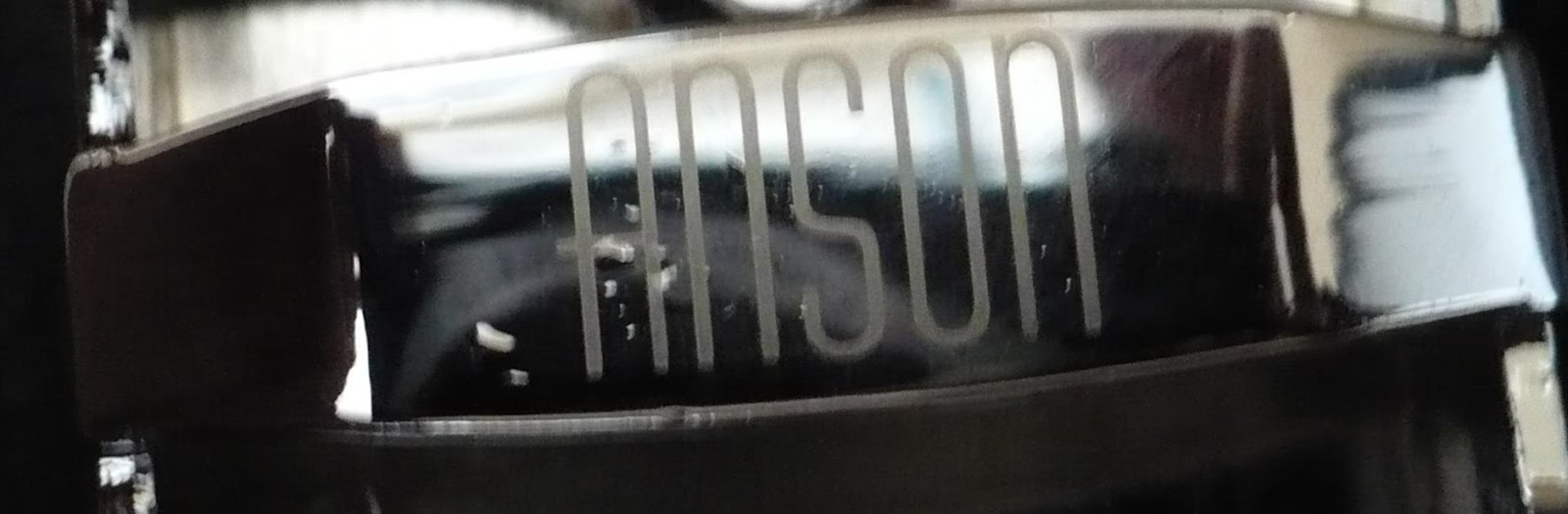
The buckles look nice from afar. However, close inspection reveals plenty of small flaws in the shiny plating.
Flaws in the plated surface of the buckle.
Granted, people won't be inspecting my belt so closely, but it is a bit of a concern because it could indicate that the plating can't handle any abuse. If that's the case, the plating would flake off with use, gradually revealing a darker, dull metal underneath. I am impressed with the simplicity of the buckles. There are only a few moving parts, which is often a good thing on any device because it means fewer things can go wrong. It only took me about 30 seconds to figure out how the whole thing works, so it'd be easy to fix if one of the smaller parts happens to break in the future. The buckle lever is held closed with a magnet rather than a spring, which is simpler and should make it much more durable than any spring-loaded mechanism. You'd have to manage to lose or demagnetize the magnet for the closure to stop working. It would've been nice if the pin for the buckle lever wasn't quite so loose in its bearings. I feel like the large amount of play in the lever makes the thing seem cheap. It was probably done to keep manufacturing costs down (it's faster and easier to slip an undersized pin into a hole). They're charging $25 USD per buckle, so the loose-fitting, cheap-feeling lever seems out of place.

I was a little disappointed in the colour of the brown belt. It's a few shades darker than I had expected. The contrast between the black and brown straps was less than the photos on the website had suggested.
Anson belt straps
Brown belt on the right.
Photo was taken with no flash in regular lighting.
Anson belt gift box D
What the website's photo shows.
Probably taken using a flash or bright studio lighting.
Seeing the words "Made in China" on the leather was also an unwelcome surprise considering the price of these belts. They sell the straps for $30 USD, which puts a complete belt at over $50. Top-grain leather belts can be found relatively easily at the same price point, and you can also get some pretty decent belts in genuine English or Italian leather. You can even get full-grain cowhide belts for less if you know where to look (full-grain is the best and most durable grade of leather), though for only $50 it might be poorly finished. I had taken the price and this guy's review to be a bit of an assurance of the quality of the leather when placing the order. I suppose it's my own fault for not contacting a sales rep first. "100% Leather" is stamped into the strap, but I know that can be a misleading statement on a product from China. I decided to dissect one of the trimmed ends.
Trimmed end of the black belt cut open and separated to expose laminae.
As you can see, the belt's made from laminated leather. Laminated leather is to leather what finish-grade plywood is to lumber. The thin outer sheets look nice, but inside you've got layers of the cheaper, lower-quality stuff. The only worse type of leather product is bonded leather, which is basically like particleboard; pieces and fibers of low-quality leather fused together. The middle layer here felt more like a tougher synthetic core than a strip of leather.

However, it's not all bad news. The fact that the belt is adjustable in 6 mm increments is a definite plus. The ratcheting system will probably prevent the kind of damage to the belt's tongue that you get over time on a traditional belt. The stitching does look good and durable. I had a good overall impression of the belt when I first took it out of all that packaging. I've certainly had worse belts (though they also didn't cost so much). As far as laminated leather belts go, these look and feel really good.

Both leather straps were 51" long. I used one of the trimmed pieces for the dissection above and the other to run a little experiment on the durability of the belt. I'll post a follow-up when that experiment's over.

Despite all of the issues I've pointed out, I'd say that I am pleased with how the belts look. I'll have to wait to see how durable the belts really are before I decide if they're worth the price.

Monday, 18 February 2013

Tailor4Less Review: Part 1 of 3


In the past few years, a huge number of online made-to-measure clothing stores have popped up. They all have a similar business model.
  1. Use a computer algorithm to get tailored clothing measurements from a few simple body measurements.
  2. Utilize programmable machines to cut the fabric to the right measurements for the customer.
  3. Utilize cheap labor to assemble the clothing.
  4. Ship to the customer.
The made-to-measure model is appealing to me because I'm not the standard shape and I don't have a lot of money to spend on formal clothing. I have broad shoulders for my otherwise very slender build. I have to choose clothes that fit my shoulders properly, but that usually means that the neck is fine, the sleeves are too short, and the rest is baggy like a woman's blouse. I priced it out once; fixing all that on a shirt using a local tailor would cost $30 - $60. So I did some research on some of these made-to-measure services.

Basically, when you order made-to-measure, you're supposed to end up with a suit (or shirt, trousers, etc.) that costs the same as a regular suit off the rack, but fits better and saves you the cost and hassle of alterations. You also get to customize little details like how you want the lapels and pockets to look. Some websites claim to sell bespoke clothing, though this is a lie. Bespoke clothing is custom clothing that is handmade by a master tailor with you as the model (rather than some "standard"). There are intermediate fittings involved to ensure that the finished product is perfect. Made-to-measure clothing on the other hand starts with a standard pattern. Before the fabric is cut, some of the standard measurements are tweaked a little based on a few of the customer's body measurements. There are no fittings involved, but the final product should fit relatively well.

The main drawbacks of these online made-to-measure services are that you lose the in-store experience. You can't feel fabrics or look at various outfit combinations like in a regular store. If you're not knowledgeable about men's fashion, the staff at menswear stores can be helpful. Furthermore, a large number of these online stores don't have a phone number you can call. Not having a phone number can make things difficult and frustrating for unsatisfied customers. It's a bit sketchy for a company not to stand behind it's product with a good system for customer service.

Tailor4Less (T4L) is one that stood out because they seem to offer some of the lowest prices and appear to be pretty popular. Most reviews are favourable, though there are a few scathing ones. Unfortunately, I can't find any positive reviews concerning their customer service. This is alarming because good customer service is important to any successful business. Some of the most valuable reviews are from people who had their problems resolved by good customer service. Most detailed reviews seem to agree that the overall fit is not truly perfect, but respectable considering the price. Of the complaints that I've found, they're usually regarding the quality of the fabric or construction. Have a look at some reviews for yourself:

http://www.trustpilot.co.uk/review/tailor4less.com
http://www.youtube.com/watch?v=GniNx0gUOqQ
http://www.styleforum.net/t/101870/comparison-of-four-online-mtm-shirt-makers
http://www.guystyleguide.com/blog/2012/01/product-review-tailor4less/
http://sartoriallysincere.blogspot.ca/2010/12/online-suit-review-tailor4lesscom.html

When researching a business, it's important to keep in mind that a few angry customers doesn't necessarily mean they're a bad company to deal with. Anyone who's dealt with customers before can tell you that some people are simply irrational. I suspect that the majority of dissatisfied customers were people expecting too much, hoping to get something for nothing. Regarding fabric, T4L doesn't claim to sell top-quality fabrics (though it looks like the website might be deliberately misleading). Don't look at the S number alone, as this is only one important thing to consider when choosing a fabric. Pay attention to thread count, fabric weight, and fabric composition. You'll see that most of the fabrics offered by T4L are representative of typical inexpensive clothing. Regarding construction, T4L doesn't explicitly tell you, but it's safe to say that for the price they're asking, you're getting the cheapest construction available. The means no canvassing, no collar stays (or cheap flimsy ones), etc. Don't expect more for these modest prices. Nobody's going to waste high quality fabrics or extra labour for careful handmade construction on clothes this cheap.

That said, a few disappointed customers have put together a website dedicated to warning people. T4L doesn't have a phone number, so if they choose to ignore you, you have no way of getting any customer service. Some people report that T4L will get bad reviews deleted, which can be done even on websites like TrustPilot if you don't agree to the terms to allow them to verify that you're an actual T4L customer.
T4L also appears to be a cooperative of companies based all over the world. The website's registered in France, owned and managed by a company in Switzerland, yet protected and operated in accordance with Spanish law. T4L appears to have two headquarters, one in Barcelona, Spain and the other in Shanghai, China. It seems that all this allows them to get away with shady business practices like:
  1. No refund policy.
  2. No clothing labels. In many countries, including Canada, the law requires garments to have labels disclosing the fabric's composition, country of origin, and care instructions.
Actual satisfaction considerably less than 100%. Garments can be remade after you pay for the extra shipping costs.
In conclusion, my research indicated that the principle of caveat emptor is more applicable than usual when dealing with T4L. However, I was still intrigued. After all, I will need appropriate, well-fitting business wear when I'm finished school and can't just go spend all my money on one suit. I decided to proceed cautiously and order some fabric samples, so there will be a sequel to this review.

Update: Links to Part 2 and Part 3