Ground vibrations can come from a large number of different sources, such as rail and vehicular traffic, jackhammering, bulldozing, pavement milling, vibratory compaction, pile driving, and blasting.
The magnitude of these vibrations can vary from being imperceptible, to causing a minor nuisance, to possibly even causing extreme damage. Generally speaking, the main factors to consider are the strength of the source vibrations, duration of exposure, distance from the source, type and condition of the affected building, and the local soil type. Our building stock and infrastructure are aging. More and more there will be a need to carry out construction activities near these aging buildings. Consequently, there will likely be a rise in the number of complaints, and insurance claims, due to construction-induced ground vibrations in the future.
Ground vibrations are typically quantified in terms of Peak Particle Velocity (PPV), usually expressed in millimetres per second (mm/s) or inches per second (in/sec). Stronger vibrations have a higher PPV. Vibrations can damage buildings directly as a result of the movement in the walls or floors, or the damage can be indirect as a result of soil movements that were caused by the vibrations. In Canada, there is no national standard for ground vibrations, but standards from other countries generally agree that ground vibrations should be limited to 5 mm/s to prevent direct damage to small residential buildings. This 5 mm/s threshold is based on empirical data and probabilities. The threshold is intended to ensure there is a very low risk of cosmetic cracking in drywall, plaster, and old unreinforced masonry. There is no guarantee that damage cannot occur at lower levels, but that would be very rare. There's also no guarantee that exceeding the 5 mm/s threshold will cause damage to a building. In fact, most buildings can tolerate stronger vibrations, especially buildings that are well-constructed, in good condition, and/or are only briefly exposed to the vibration.
Whether or not an activity will exceed a vibration threshold depends on the distance from the source, local soils, and the strength of the source vibrations. Weak and soft soils are good at dissipating vibrations, while hard soils or rock can transmit vibrations a long way. Just think of how you would feel the vibrations in your hands if you swung a steel pipe at concrete wall as hard as you could, and how different your hands would feel if you swung a pillow instead. But remember, the 5 mm/s threshold is for direct damage to the building, so it might not be applicable if the building sits on a soil that is susceptible to vibrations, making the building vulnerable to indirect damage.
Susceptibility to indirect damage depends on the local soil and the duration of exposure to vibrations. Susceptible soils include sand, gravel, and some fine-grained soils known as loess. These soils can be consolidated by vibrations, which can in turn result in foundation movement and cracking. Imagine the particles in a loosely compacted sand are like a house of cards. The vibration makes the particles move around and fall into a more compact configuration, like when a house of cards collapses. The amount of consolidation that can take place depends on how well these soils were compacted beforehand and how long they're exposed to the vibrations. There are no standards limiting vibrations to prevent soil consolidation because more research into the problem is needed. However, most vibration standards at least recognize that problems can occur with loose granular soils and recommend that a geotechnical engineer be consulted. Limited available empirical data on damage caused by vibration-induced soil consolidation shows that some buildings in loess soils have been damaged at vibration levels below 1 mm/s. Therefore, both the soil characteristics and the ground vibrations need to be considered together when investigating vibration damage.
Building occupants are typically much more sensitive to vibrations than the structures themselves. Vibrations of just 0.3 mm/s could be sufficient to disturb some homeowners and vibrations of about 1 mm/s are likely to cause complaints. A vibratory roller compactor working in an area with hard soils might cause complaints more than 400 feet away! Therefore, the sensitivity of the occupants is frequently an issue with vibration damage claims. Often, when building owners perceive nuisance vibrations they go looking for damage afterwards. They then find a number of cracks that they hadn't ever paid any attention to before. In many cases, most or all of the damage reported was actually pre-existing.
Cracking caused by ground vibrations may be indistinguishable from other common types of damage, like cracking from thermal and moisture movements or small foundation settlements. Therefore, a vibration damage investigation involves a lot more than a visual examination. Additional information needs to be considered, including the local soil conditions, type of building involved, general condition of the building, and the duration, frequency, and source location of the vibrations. Documentation of pre-existing conditions can be the most valuable information for an investigation.
If you look hard enough, you'll find cracks in any house. If you're a homeowner, it's a good idea to looking for cracks once in a while and document them with photos. You should also do this as soon as you see any major construction work going on nearby. That way, if damage does occur, you will have some documentation of existing conditions from when the construction work started. That record of pre-existing conditions will help in determining the extent of the damages.
If you're a contractor, the best way to prevent complaints is to inform nearby property owners about the ground vibrations they can expect and to conduct pre-construction surveys to document any existing cracks. Nuisance vibrations are more tolerable when they are expected, and if you do the pre-construction survey then owners won't be discovering pre-existing cracks while the construction work is going on. And if damage does occur, that record of pre-existing conditions will help limit the costs to just the vibration damage.
References
Dowding, C.H. (2000). Construction Vibrations. Second edition. Prentice Hall, Upper Saddle River, NJ.
Svinkin, M.R. (2012). "The necessity of condition surveys for structural protection against pile driving effects," Proceedings of the 9th International Conference on Testing and Design Methods for Deep Foundations, T. Matsumoto, ed., Kanazawa e-Publishing, Japan, 429-439.
Svinkin, M.R. (2015). "Tolerable Limits of Construction Vibrations," Practice Periodical on Structural Design and Construction. 10.1061/(ASCE)SC.1943-5576.0000223.
Wiss, J.F. and Parmalee, R.A. (1974). "Human Perception of Transient Vibrations," Journal of the Structural Division, ASCE, Vol. 100, No. S74, pp. 773-787.
Showing posts with label building. Show all posts
Monday, 28 November 2016
Friday, 16 September 2016
Masonry Patterns
The
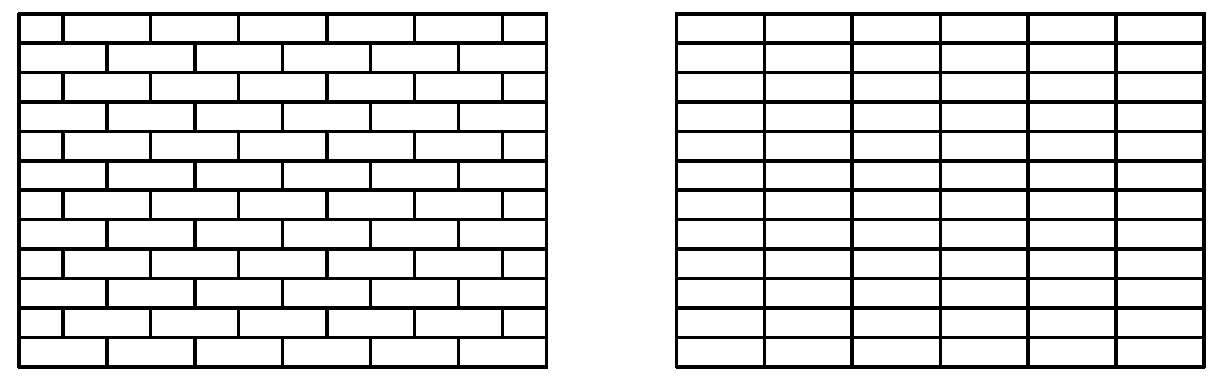
simplest and most common patterns in modern masonry construction are running
bond and stack bond. In running bond, masonry units in one course are centred
over the head joints in the course below. As any child who’s experimented with
blocks knows, this interlocking pattern helps distribute loads and makes the
structure more robust. In stack bond, masonry units line up directly with those
in the course below. The continuous head and bed joints give the masonry a
distinct grid pattern that can have a pleasing aesthetic, particularly when the
mortar joints are raked. However, masonry constructed in stack bond is weaker
and less robust than masonry constructed in running bond. That said, a
carefully designed structure that properly utilizes the modular dimensions of
concrete blocks can potentially be less expensive to build in stack bond
pattern than in running bond pattern because there’s no need to cut half-blocks
at openings.
Figure
1: Running Bond (left) and Stack Bond (right).
Variations of running bond where the offset from one course to the next is
somewhere between half a unit (ordinary running bond) and zero (stack bond) are
also fairly common. While there could be an infinite number of possibilities
here, the most common running bond variants are one-third running bond (1/3
offset) and one-quarter running bond (1/4 offset).
Figure
2: One-Third Running Bond (left) and One-Quarter Running Bond (right).
In
addition to the patterns still in common use, there are dozens of other
possible patterns; too many to discuss. Some of which were common in the past
when multi-wythe construction was common, and some are rare patterns that were
simply invented to create unique aesthetics. Below are just a few examples of
the different patterns in existence:
| Figure 3 (from left to right): 45° Herringbone Bond, Diagonal Bond, Double Basket Weave Bond, and Pinwheel Bond. |
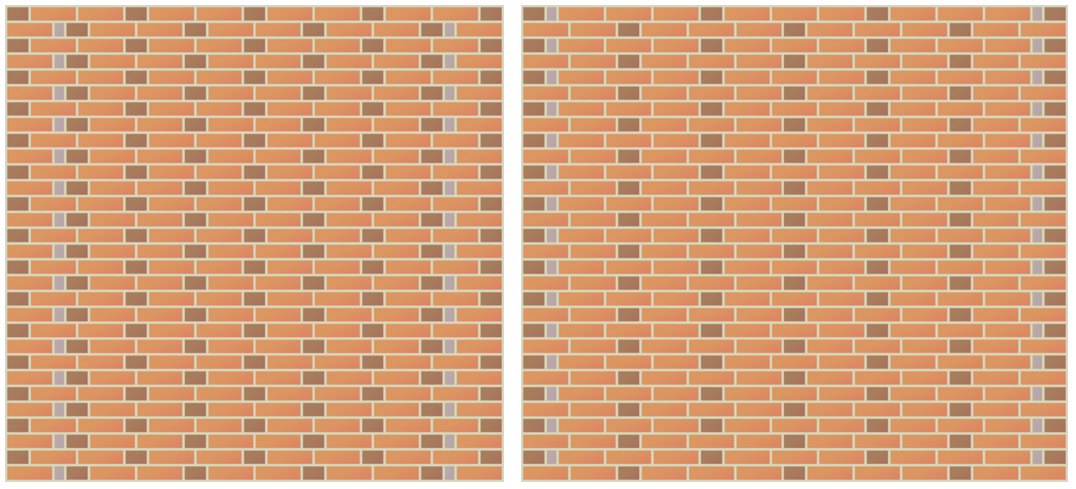
| Figure 4: American Bond (left) and Scottish Bond (right). Headers shown in brown, stretchers in orange, and queen closers in grey. |
| Figure 5: English Bond (left) and Flemish Bond (right). Headers shown in brown, stretchers in orange, and queen closers in grey. |
| Figure 6: Monk Bond (left) and Sussex Bond (right). Headers shown in brown, stretchers in orange, and queen closers in grey. |
References
BIA.
(1975). Technical Note 2: Glossary of
Terms Relating to Brick Masonry. Brick Industry Association, Reston, VA.
BIA.
(1999). Technical Note 30: Bonds and
Patterns in Brickwork. Brick Industry Association, Reston, VA.
Brunskill,
R. W. (1997). Brick Building in Britain.
Gollancz, London, UK.
Hatzinikolas,
M. A. and Korany, Y. (2005). Masonry
Design for Engineers and Architects. Canadian Masonry Publications,
Edmonton, Alberta.
Lloyd,
N. (1925). A History of English Brickwork.
Antique Collectors’ Club, Woodbridge, UK.
Wednesday, 25 March 2015
What is AAC?
Autoclaved aerated concrete (AAC) is an
economical material used to produce a variety of building products, ranging
from precast wall and roof panels to masonry blocks and lintels. AAC was
invented in Sweden in 1923 and has been a popular building material in Europe
for more than 50 years. However, AAC didn’t become commercially available in North
America until around 1990 and the North American construction industry has been
slow to embrace this innovation in concrete technology.
![]() |
| Close-up view of a sample of autoclaved aerated concrete Photo by Marco Bernardini |
The raw materials that go into AAC are a
mixture of Portland cement, lime, silica sand, water, and aluminum powder. Fly
ash (a byproduct of coal-burning powerplants) is sometimes also added, which
provides some environmental benefits by reducing the amount of Portland cement
required in the mix (Portland cement production results in significant carbon
dioxide emissions) and keeping some fly ash out of landfills. The fresh
concrete mix is then poured into a mold. Chemicals reactions between the
aluminum and the hydrated cement cause many microscopic hydrogen gas bubbles to
form in the fresh concrete and the mix expands to approximately five times its
original volume. The hydrogen gas dissipates to the atmosphere, leaving behind
a highly aerated concrete. The concrete is given just enough time to solidify
and gain enough strength to hold its shape. Then, the aerated concrete is cut to
the desired size and shape and is placed in a pressurized chamber, called an
autoclave, where the concrete is steam-cured. Steam-curing helps the concrete
gain strength more rapidly and more uniformly through the thickness relative to
air curing.
AAC is available in a number of shapes and
sizes. Panels are 600 mm (24”) wide, typically 200 mm to 300 mm (8” to 12”)
thick, and up to 6100 mm (20’) long. Blocks are 200 mm (8”) high and are
available in lengths of 600, 800, and 1200 mm (24”, 32”, and 48”) and thicknesses
between 100 to 400 mm (4” to 16”).
The porous internal structure of AAC makes
AAC much lighter than traditional solid concrete (AAC floats in water!) while
still maintaining good fire resistance and noise attenuation properties. Reduced
weight of the structure might permit some cost savings on the foundation
construction. In seismic regions, reduced weight has the additional benefit of
smaller earthquake forces. A traditional 200 mm (8”) thick hollow concrete masonry
wall weighs about 215 kg/m² (44 lbs/ft²), has a Sound Transmission Class of
about 48 and a 2-hour fire rating, while a wall of the same thickness
constructed using solid AAC blocks would weigh about 122 kg/m² (25 lbs/ft²),
have a Sound Transmission Class of about 45, and a 4-hour fire rating. Thermal
resistance is also significantly improved in AAC. Traditional solid concrete
has a thermal resistance of about RSI-0.49 to RSI-0.69 per metre (R-0.07 to
R-0.10 per inch), compared to about RSI-5.55 to RSI-8.67 per metre (R-0.80 to R-1.25
per inch) for AAC.
However, there are some drawbacks to
consider. AAC isn’t as strong as traditional concrete, so it might not be
suitable where there are significant structural loads to carry. The specified
compressive strength of hollow concrete block masonry is typically about 7 to
18 MPa, compared to about 2 to 6 MPa in AAC masonry. AAC is generally not
suitable for exterior exposures unless it is protected with an exterior
cladding or parging because AAC is more susceptible to impact damage,
freeze-thaw damage, and moisture intrusion. That said, there are many examples
of successful use of AAC masonry in the building envelopes, such as the
buildings shown below:
![]() |
| Hualapai Head Start, Arizona |
![]() |
| Trotwood Middle School, Ohio |
In short, AAC is essentially a kind of concrete foam. It's lightweight, better for the environment, and has good noise attenuation, fire resistance, and thermal insulation properties.
References
- Bernardini, M. Aerated autoclaved concrete – close-up view. Personal photograph.
- CSA. (2004). CSA Standard S304.1-04: Design of Masonry Structures. Canadian Standards Association, Mississauga, ON.
- Klingner, R. E. Using Autoclaved Aerated Concrete Correctly. Masonry Magazine, June 2008.
- MSJC. (2013). Building Code Requirements and Specification for Masonry Structures, Containing TMS 402-13/ACI 530-13/ASCE 5-13, TMS 602-13/ACI 530.1-13/ASCE 6-13, and Companion Commentaries. Masonry Standard Joint Committee.
- van Boggelen, W. (2014). History of Autoclaved Aerated Concrete: The short story of a long lasting building material. http://goo.gl/KuyYL8
Sunday, 22 March 2015
Masonry Terminology
Construction
terminology can be confusing, especially where masonry is concerned. Many terms
unique to masonry construction can leave laypeople scratching their heads. In
this post, we make sense of some of the terminology used within the masonry
industry.
Masonry
is simply an assemblage of modular units,
which are usually either solid bricks or hollow blocks. Units are typically
bound together with mortar made from
sand, water, and cement. Other options for assembling the units also exist,
such as dry-stacked masonry, where no
binder is used, interlocking masonry,
where the units fit together like puzzle pieces to provide mechanical
connection to each other, and glued
masonry, where units are bound together with a thin layer of adhesive.
A layer of a wall that is
one unit thick is called a wythe,
though the term leaf is also
sometimes used. A row of units along the length of the wall is known as a course. Horizontal mortar joints are
called bed joints and vertical
mortar joints are called head joints.
Masonry units can be laid in six different orientations, each of which has been given a name to differentiate them: stretcher, header, rowlock, soldier, sailor, and shiner. Stretchers are laid with the long, narrow side facing out and the long edge horizontal. Soldiers are also laid with the long, narrow side facing out, but the long edge is vertical. Headers are laid on their broad side, like stretchers, but have the small face exposed. Rowlocks also have the small face exposed but are laid on the long, narrow side. Sailors and shiners are laid with the broad side exposed and the long edge vertical for sailors or the long edge horizontal for shiners.
Hollow
blocks are typically laid as stretchers, occasionally as headers, and should never
be laid as sailors or shiners. Solid bricks are also typically laid as
stretchers, but headers, rowlocks, and soldiers are also pretty common,
especially in older buildings. Sailors and shiners are rare in solid brick
masonry, but have been used in the past to produce some interesting brickwork
patterns. Masonry is strongest when loaded as a stretcher or header, so
rowlocks, soldiers, sailors, and shiners are typically used for decorative
purposes where the strength demand is low.
After the bricks have been laid, the mortar joints have to be finished. Mortar joints can be finished in several different ways to produce different aesthetics, as illustrated below.
The
most common joints are concave
joints (occasionally called bucket
handle joints), which provide a finished look without negatively affecting
the overall strength or ability to manage moisture. Flush joints work well for masonry that will be coated with parging
or plaster because flush joints aren’t as likely to show through the coating as
it ages. Raked joints are made by
raking out some of the mortar before it hardens. This emphasizes the edges of
the units and can create a good aesthetic. However, raked joints are generally
weaker and more susceptible to moisture intrusion than most other joints. Extruded joints, also known as weeping joints and occasionally called skintled joints, are really just
unfinished joints. The extrusion is formed from mortar that’s squeezed out of the
joint when the brick is laid in place. Some people like extruded joints,
claiming they give the brickwork a rustic look, while others feel extruded
joints just look messy and unprofessional.
We
looked at some of the different terminology used within the masonry industry,
including the six orientations of a brick and nine different ways to finish
mortar joints. In a follow-up post we will take a closer look at some of the
many different patterns masonry can be constructed in.
References
BIA. (1975). Technical Note 2: Glossary of Terms Relating to Brick Masonry. Brick Industry Association, Reston, VA.
Brunskill, R. W. (1997). Brick Building in Britain. Gollancz, London, UK.
Hatzinikolas, M. A. and Korany, Y. (2005). Masonry Design for Engineers and Architects. Canadian Masonry Publications, Edmonton, AB.
Lloyd, N. (1925). A History of English Brickwork. Antique Collectors' Club, Woodbridge, UK.
Thursday, 18 December 2014
Winter Condensation and Frosty Windows
Another
winter is upon us, and for many Canadians, that means having to deal with
condensation and frosting on windows. Besides being a nuisance, excessive
condensation on windows may eventually cause damage to window frames or
finishes near the window opening. What causes condensation and frosting, and
what can be done to prevent it?
![]() |
| Though occasionally beautiful, frost on a window is often a problem. |
Condensation
forms on surfaces that are colder than the dew point temperature (DPT) of the
air. The maximum amount of water vapour that can mix with air depends on the
temperature: warmer air can hold more moisture. Air at 20 °C can have nearly 23 times more water vapour than air at -20
°C! If air cools below its DPT, water vapour will leave the air to form
condensation.
In
the past, houses tended to stay dry because they were drafty and moisture in
the home was quickly carried outdoors. Modern homes are constructed to minimize
air leakage. This saves on heating costs, but also traps more moisture inside
the home. At the same time, windows are relatively poor thermal insulators. A
significant proportion of heat loss through windows is actually resisted by a
thin layer of air that clings to the interior side of the window, rather than
by the window material. The window material is analogous to the exterior siding
of a wall and the air layer is analogous to the wall’s insulation. Anything
outside the insulation gets very cold during winter. When warm, moist air from
inside the home reaches one of these cold windows, the air cools and vapour
condenses or freezes.
Most
approaches to controlling condensation are simply measures to reduce the amount
of water vapour in the home, which is equivalent to reducing the DPT. Here are
some tips on reducing indoor humidity:
- Turn off humidifiers.
- Use a dehumidifier.
- Use cold water for washing dishes and clothing.
- Ensure dryers are properly vented to the exterior and that dryer ducts are not leaking.
- Take quicker showers. Showering produces approximately 2.6 kg of vapour per hour (1 kg of vapour is equivalent to 1 L, or about 34 oz, of liquid water).
- Use exhaust fans while cooking or showering. Cooking a meal for four people produces about 0.2 to 0.3 kg of water vapour on average.
- Don’t boil water unnecessarily. Try brewing tea or preparing soup at a few degrees below boiling.
- Store firewood in the garage or shed. Drying firewood produces 1 to 3 kg of vapour per day per cord of firewood.
- Reduce the number of plants in the home. A typical house plant releases about 0.05 kg of water per day.
- Open the windows or doors (at least once in a while) to increase ventilation. This will increase your heating bill, but it will also help remove moisture.
- Install a heat recovery ventilator (HRV). Direct exchange of warm indoor air with cold outdoor air results in significant heat loss. HRVs perform this air exchange while reducing that heat loss by 75 to 85%.
Guidelines
developed at the University of Minnesota recommend indoor humidity below 30% to
control condensation when the outdoor temperature is -12 to -18 °C. However, it
should be noted that low humidity can pose comfort and even health problems for
some people. Complaints of chapped lips, dry skin, and dry nasal passages
become increasingly likely as the indoor humidity drops below 30%. Low humidity
also causes wood to shrink, which sometimes leads to warping or checking. Most
flooring manufacturers recommend keeping humidity between 35% and 55% to
protect hardwood floors. Other wooden items in the home like furniture and
musical instruments may also be sensitive to low humidity. So if you can’t
solve your condensation problems by reducing indoor humidity, there are still some
other options that work by stopping moisture from reaching the cold surface or
by ensuring the surface temperature doesn’t drop below the DPT. Here are some
additional tips for controlling condensation:
- Open drapes and blinds. This encourages air circulation at the window and keeps the window surface a little bit warmer.
- Install a plastic film (window insulator kit). It is important to seal the plastic correctly so that air can’t leak around it. If the film leaks air it could actually exacerbate the condensation issues.
- Install storm windows if not already present.
- Check the window seals and take corrective action as necessary. In storm window assemblies, the inner window should be as airtight as possible and the outer window should be comparatively leaky, though not so leaky that it allows exterior air to chill the inner window.
- Replace problem windows with more efficient models. Choose windows with a high Condensation Resistance Factor (CRF).
To
summarize, condensation and frost form on windows because the windows are
colder than the dew point temperature of the indoor air. Reducing vapour
production and removing vapour from the home are often the best ways to
eliminate condensation problems. If problems persist, repair or renovation work
ranging from weather-stripping windows to replacing windows with more efficient
models may need to be considered.
References
ASHRAE. Handbook
of Fundamentals. American Society of heating Refrigeration and
Air-conditioning Engineers, Atlanta, GA, 2009.
Hutcheon, N.B. and Handegord, G.O.P. Building Science for a Cold Climate.
John Wiley & Sons, New York, NY, 1983.
Lohonyai, A.J. Frost
fractals on a window, Personal photograph, November 2014.
Straube, J.F. and Burnett, E.F.P. Building Science for Building Enclosures, Building Science Press,
Westford, MA, 2005.
TenWolde, A. and Pilon, C.L. “The Effect of Indoor
Humidity on Water Vapor Release in Homes” in Thermal Performance of the Exterior Envelopes of Buildings X, American Society of heating Refrigeration
and Air-conditioning Engineers, Atlanta, GA, 2007.
Trechsel, H.R. and Bomberg, M.T. (eds.) Moisture Control in Buildings: The Key Factor in Mold Prevention, 2nd edition, American Society for Testing and Materials, West Conshohocken, PA, 2009.
Thursday, 19 September 2013
About Architects, Engineers, and Contractors
An architect is said to be a person who knows very little about a great deal and keeps knowing less and less about more and more until he knows practically nothing about everything.
On the other hand, an engineer is a person who knows a great deal about very little and goes along knowing more and more about less and less until finally he knows practically everything about nothing.
A contractor starts out knowing practically everything about everything, but ends up knowing nothing about anything due to his association with architects and engineers.
Yet they still somehow manage to create things like these when you put them together:
![]() |
| Kinemax building at Futuroscope, Poitiers, France. |
![]() |
| Habitat 67, Montreal, Quebec, Canada. |
![]() |
| Civil Justice Center, Manchester, United Kingdom. |
![]() |
| Sydney Opera House, Sydney, Australia. |
![]() |
| Walt Disney Concert Hall, Los Angeles, California, USA. |
![]() |
| Guggenheim Museum, Bilbao, Spain. |
![]() |
| Dancing Building, Prague, Czech Republic. |
![]() |
| Stata Center, Cambridge, Massachusetts, USA. |
![]() |
| Darcons Headquarters, Delicias City, Mexico. |
Subscribe to:
Comments (Atom)


.jpg)